The New York Times report on possible links between some of Iran's dams, water transfer projects, and underground military facilities has drawn sharp reactions. Some have welcomed it as an important investigation. Others fear it could be used to justify attacks on Iran's water infrastructure. A few have gone further, suggesting that the experts who contributed to the report have somehow helped make Iranian dams potential military targets.
The concerns about civilian infrastructure are understandable. Iran is at war, and attacks on dams and water supply systems could be devastating. But something else about the reactions is troubling. In all the noise, a question that should have been asked years ago is once again being pushed aside: why has the Islamic Revolutionary Guard Corps been allowed to play such a dominant role in Iran's water sector, and who has been holding it accountable?
Years of reporting have exposed the workings of what has become known as Iran's water mafia: a network of politically connected contractors, engineering consultants, government officials, and institutions that have shaped some of the country's most expensive and environmentally destructive water projects. The IRGC is a major part of that network, but by no means its only player.
In a democratic country, the military cannot spend public money without proper oversight simply by claiming to protect national security. Governments have a duty to protect genuine defense secrets. They also have a duty to explain how public funds are spent, particularly when the projects involved may change the lives of millions of people for generations. A dam is not a state secret, and neither is the environmental destruction caused by building one.
Yet in Iran, the line between civilian infrastructure, economic interests, and military activity has become increasingly hard to see. Since the end of the Iran-Iraq War, Khatam al-Anbiya Construction Headquarters, the IRGC's engineering and construction arm, has grown into one of the country's most powerful contracting organizations. It has been involved in dams, water transfer tunnels, oil and gas projects, and other major infrastructure. Its affiliated companies have secured enormous government contracts, often in a system where meaningful competition and independent oversight have been limited.
This is hardly breaking news. The U.S. Treasury Department described Khatam's extensive economic activities and ties to the IRGC back in 2010. The UN Security Council also documented the involvement of Khatam-affiliated companies in building the Fordow uranium enrichment facility, along with the organization's participation in projects associated with Iran's Passive Defense Organization. So the same construction establishment has worked on both civilian infrastructure and sensitive military projects. What remains unclear is whether particular equipment, expertise, or public money moved between the two, and a serious investigation should start there.
A 2021 investigation by Nik Kowsar for the Middle East Institute examined how the IRGC had become a powerful player in Iran's water sector. It also made clear that the problem went beyond military contractors. Engineering consulting firms, government agencies, and civilian officials had helped create a system in which questionable projects could proceed despite serious technical and environmental objections.
According to accounts from people familiar with the Ministry of Energy's decision-making, some projects were effectively approved before the official reviews were completed, and the paperwork followed. Technical assessments and administrative approvals became formalities meant to legitimize decisions already made elsewhere, with experts left to write up the minutes after the fact.
The consequences have been enormous. Iran has spent vast sums on dams and interbasin water transfers while aquifers have been depleted, rivers have suffered, and entire communities have paid the price. Gotvand Dam is a revealing example, and far from the only one. The salt-bearing formations around its reservoir did not appear overnight. A 2019 scientific study documented the scale of salt dissolution after the reservoir was filled. The project left behind a serious and costly environmental problem that no patriotic speech or ribbon-cutting ceremony will solve.
When billions are committed to major infrastructure, the public has a right to ask who proposed the project, who approved it, who received the contracts, whether cheaper alternatives existed, and who will bear the costs if things go wrong. The IRGC should not be exempt from those questions. Neither should the Ministry of Energy, engineering consultants, or politically connected civilian contractors.
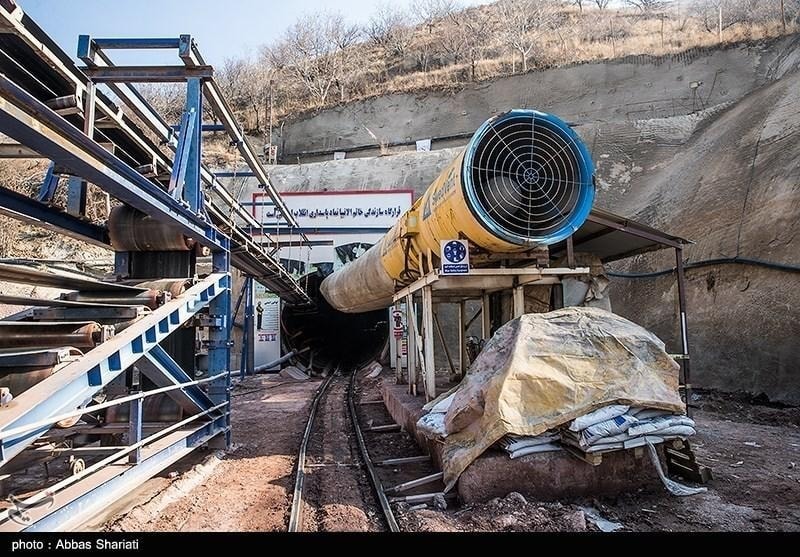
Another part of this story has received far less attention: the equipment and expertise developed for tunneling. Iran's large water transfer schemes required sophisticated engineering, geological studies, specialized contractors, and tunnel boring machines, commonly known as TBMs. These machines were brought into the country for civilian projects, including water transfers and transportation infrastructure. A dam stays where it is built, but machines and experienced crews can be reassigned, which raises the question of what happened to that capacity once individual projects were finished.
In a November 10 investigation published by Khodnevis, information was presented from a water management specialist who had previously worked with Mahab Ghodss, one of Iran's major engineering consulting firms. The source described TBM-related equipment reportedly operating in an area of central Iran that, to his knowledge, was neither an active mining site nor part of a known water transfer project. His account also raised geological questions about the nature of the reported excavation. The activity, its purpose, and the identity of the organization responsible have not been independently established.
The account falls well short of proof that water transfer machines were used to build missile facilities. Still, it raises fair questions about what became of major excavation equipment, particularly when the organizations involved have documented connections to both civilian and military construction.
The same applies to foreign manufacturers that supplied tunneling equipment to Iran. Some European companies have maintained that their machinery was sold for civilian projects, and that may well have been its original purpose. But what happened after delivery? Who owned the machines? Could they be reassigned? Were there restrictions on their later use, and was anyone responsible for checking? A civilian-use clause in a contract signed years ago says little about where a machine is working today.
There are also unresolved questions about whether water transfer projects have supplied facilities connected to Iran's nuclear program. In an August 2025 Foreign Policy article, Nik Kowsar and Alireza Nader referred to information concerning a 2006 report attributed to the Isfahan Governorate. According to experts familiar with classified records, at least 6.5 million cubic meters of transferred water had been allocated to a nuclear facility. The underlying document still needs independent examination. Unofficial claims have also linked the Qomrud water transfer project to Fordow, but no evidence strong enough to establish that link has been made public, and the secrecy of Iranian authorities should not be answered with speculation.
As for the New York Times report, it raises questions worth pursuing, but geographical proximity proves little on its own. A dam close to an underground military facility was not necessarily built for military purposes. Many Iranian dams provide drinking water, irrigation, or electricity. Their civilian functions are real, even when their planning, location, or environmental consequences deserve criticism.
Attacks on civilian water infrastructure must be opposed. Dams, drinking water systems, treatment facilities, and water transfer networks are essential to people's survival, and destroying them can have consequences that last long after a war ends. This concern predates the New York Times investigation; a March 2026 Foreign Policy article warned about the dangers of attacks on vital water infrastructure.
Opposing such attacks, however, places no obligation on anyone to defend the IRGC's role in building and controlling that infrastructure. Some commentators seem determined to merge these two positions. Question the IRGC's involvement in water projects, and the critic is accused of wanting dams bombed. Raise concerns about environmental damage, and the answer is that this is no time to criticize the country's infrastructure. Apparently, there is never a good time.
During peace, national development is used to justify questionable projects. During war, national security becomes the reason not to question them. Under this arrangement, the public pays the bills but rarely gets to examine the receipts, which should concern anyone who claims to care about Iran's future.
Some of the reactions to the New York Times report undoubtedly reflect genuine fear. People understand what attacks on water infrastructure can mean, and their concerns deserve respect. Others, though, have gone beyond criticizing the report and have attributed to experts positions those experts never expressed. It is a familiar way of avoiding an uncomfortable question: attack the critic's motives, demand a declaration of patriotism, and soon the original issue has disappeared while the person who raised it is busy proving he does not want his own country destroyed. Iranian political life has seen more than enough of this.
There is also the matter of relationships between the media and institutions that profit from major water projects. Journalists have described accounts of payments, gifts, gold coins, and financial incentives allegedly connected to favorable coverage of construction projects. These accounts require credible evidence before any individual can be accused of misconduct. But the broader question of financial relationships, promotional arrangements, and conflicts of interest within environmental journalism deserves independent investigation.
In a country where powerful institutions control enormous contracts and can also exert political and security pressure, independent reporting is not easy. Some journalists may avoid certain subjects out of fear. Others may have legitimate differences of opinion. Their motivations cannot be established through guesswork, and criticism should be directed at what they actually say and do.
The IRGC has become an economic and engineering power whose civilian and military activities overlap. The public deserves to know how that power has been used, what it has cost, and whether resources meant for civilian development went to other purposes. Nobody needs to believe that every dam hides a military facility, or that every water tunnel has a secret destination, to ask that those who spend public money account for it. The questions about tunneling equipment, water allocations, and underground construction should be investigated through contracts, procurement records, financial audits, and other verifiable evidence. Political loyalties, online campaigns, and assumptions drawn from maps cannot settle them.
Finally, defending Iran must not mean defending every decision made by the Islamic Republic or the IRGC. Iran's rivers, aquifers, wetlands, forests, and the communities that depend on them are as much a part of national security as its borders. A government that damages those resources through reckless development cannot escape responsibility simply by invoking the need to defend the homeland.
People have the right to protect their country's infrastructure from war. They also have the right to ask what their government has done with their water, their land, and their money, and one right must never be used to silence the other.